
Mexico’s Infrastructure Boom: 5 Projects Manufacturers Should Watch in 2026
If you’ve been hearing more buzz about nearshoring lately, you’re not imagining things — and infrastructure is a big reason why. Today, Mexico isn’t just welcoming manufacturers with competitive labor and trade access. It’s investing billions into the highways, rail links, ports, and energy grids that will define the next chapter of regional supply chains.
From Green Corridors to cross-border freight expansions, ground is being broken, freight is moving, and location strategies for U.S. companies are shaping up right now. If infrastructure used to be an afterthought in your site selection process, this is the year it moves to the front of the line.
Table of Contents
1. The Monterrey–Laredo Elevated Freight Corridor is a game changer
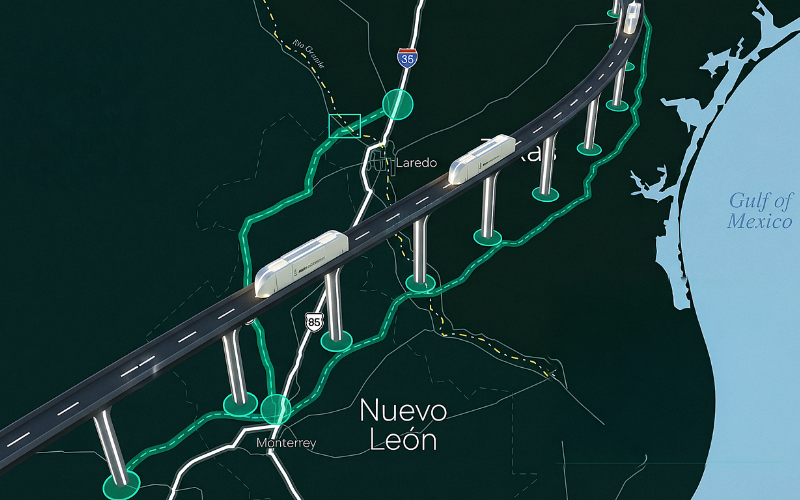
Let’s start with one of the most talked-about projects: the Monterrey–Laredo elevated freight corridor. This 120+ kilometer toll highway, purpose-built for trucks, is designed to ease congestion, reduce customs delays, and shave hours off cross-border logistics timelines. More than just a “smart highway,” the corridor will serve as a lifeline for manufacturers who need speed and predictability when moving goods north.
By separating freight traffic from passenger flow and linking directly to key industrial zones in Nuevo León, the corridor is expected to boost capacity by as much as 40 percent between Monterrey and the Colombia Bridge, a port of entry that itself is undergoing major expansion.
2. The Green Corridors initiative is driving sustainable logistics
Nearshoring isn’t just about getting closer — it’s also about getting greener. Mexico’s Green Corridors initiative aims to electrify and decarbonize key supply chain routes, starting with the Monterrey–Saltillo–San Luis Potosí stretch. With government support and private-sector buy-in, charging stations, EV-friendly trucking lanes, and clean energy zones are in development — helping manufacturers meet both ESG goals and cross-border efficiency needs.
Sustainability is becoming a key selection factor for OEMs and Tier 1s alike, and the Green Corridors plan positions Mexico to offer greener end-to-end solutions faster than many global competitors.
3. The Interoceanic Corridor is opening new east-west pathways
The Isthmus of Tehuantepec, long seen as Mexico’s overlooked logistics shortcut, is finally getting the spotlight. The Interoceanic Corridor project is revitalizing rail and highway infrastructure between the ports of Salina Cruz (Pacific) and Coatzacoalcos (Gulf), giving manufacturers an alternative to the Panama Canal and a faster path to both Atlantic and Pacific markets.
While the corridor is still maturing, early progress is attracting attention from companies looking to build flexibility into their distribution models, especially those exporting to Europe or South America.
4. Energy infrastructure is quietly catching up — and powering growth
No infrastructure strategy is complete without power. CFE, Mexico’s state utility, is actively investing in grid capacity across high-demand regions, including northern states like Nuevo León and Coahuila, as well as central zones like Querétaro and Guanajuato. These upgrades support the growing number of industrial parks coming online, while new natural gas pipelines and renewable energy projects are expanding future resilience.
If your operations require energy certainty (think cold storage, robotics, or high-speed automation), these upgrades could be the difference between meeting demand and missing opportunity.
5. Bajío’s multimodal hubs are redefining inland logistics
Finally, the Bajío region is quietly becoming the logistics backbone of central Mexico. With multimodal hubs like the Bajío Logistics Gateway in Celaya and rail-linked industrial parks expanding across Guanajuato and Querétaro, companies are finding they can land, produce, and ship in-region without depending exclusively on northern border crossings.
These hubs combine road, rail, and warehouse capabilities in purpose-built zones designed for export manufacturing — and they’re being rapidly absorbed by global firms moving now, not later.
Infrastructure isn’t just supporting nearshoring — it’s accelerating it
What all of these projects have in common is this: they’re reducing time, adding flexibility, and giving manufacturers more control over their supply chain destiny. And they’re not five years out — they’re happening now. Companies who wait for ribbon cuttings may find that the best locations have already been taken.
For U.S. manufacturers evaluating expansion in 2026, Mexico’s infrastructure investments aren’t background noise. They’re your signal. And the window to act is wide open.