
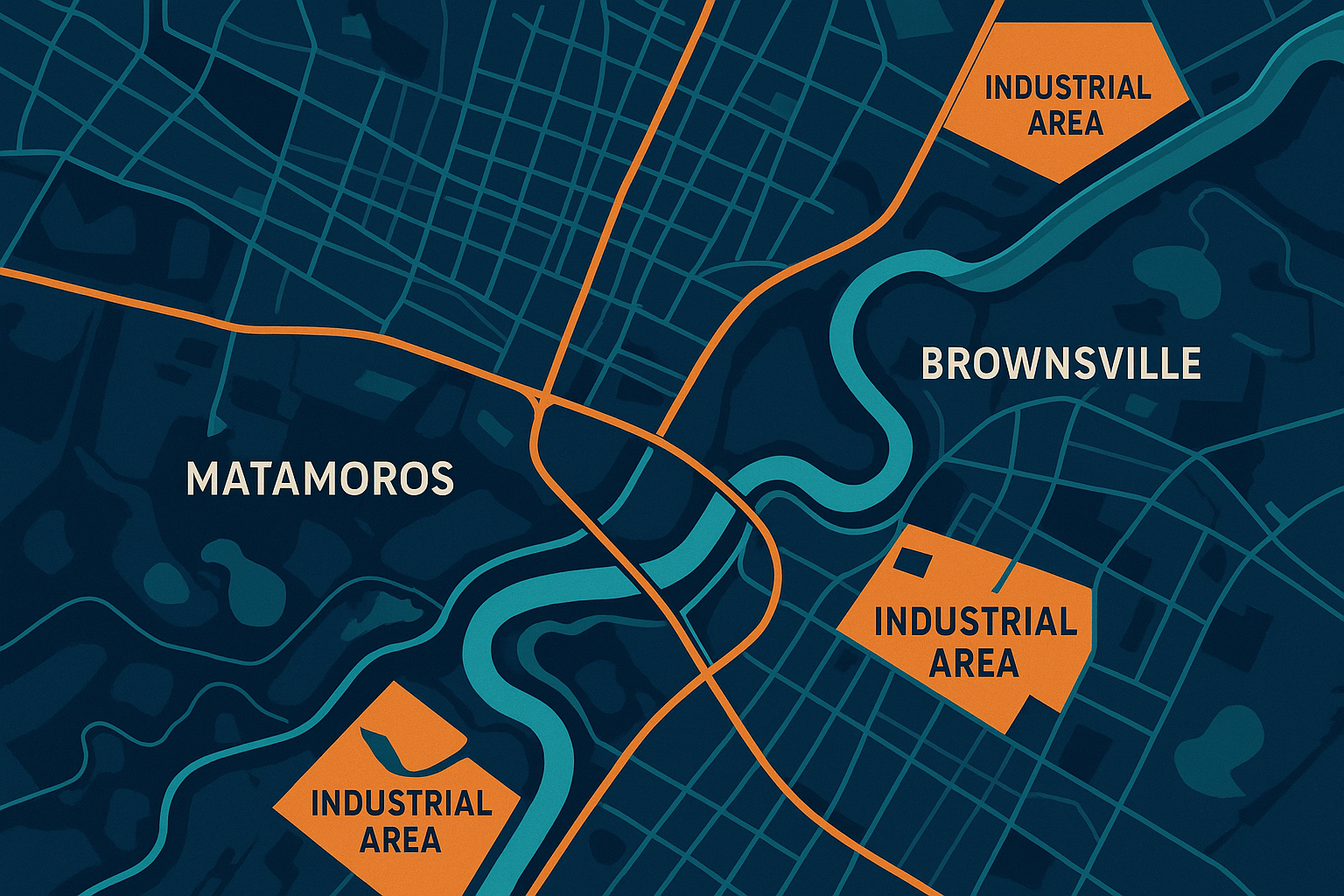
Matamoros and Brownsville: The New Cross-Border Growth Story
If you want to see the future of North American manufacturing and trade, look no further than the twin cities of Brownsville, Texas, and Matamoros, Tamaulipas. Once seen as sleepy border towns, the region is rapidly becoming one of the most important cross-border trade corridors in the Western Hemisphere.
As global supply chains shorten and companies seek cost-effective, long-term solutions closer to home, the Rio Grande Valley is emerging as a central artery of North America’s economic growth. The U.S.-Mexico border has long been a symbol of movement and exchange — but today, it’s becoming something far more strategic: a manufacturing hub designed for the realities of a rebalanced global economy.
Table of Contents
A River Runs Through It — And Opportunity Flows With It
The Rio Grande has always been more than a line on the map. It’s a living connection between two nations whose fates — and economies — have never been separate. Historian-minded observers might appreciate the parallel Jacob Shapiro drew when he described Matamoros and Brownsville as “the New Orleans of the Rio Grande.” In the same way that New Orleans’ position on the Mississippi made it the beating heart of 19th-century American commerce, Matamoros and Brownsville are becoming the critical junction for modern international trade and supply chain efficiency.
That comparison isn’t just poetic — it’s practical. The United States-Mexico-Canada Agreement (USMCA) has created an environment where free trade agreements and aligned industrial policies make this corridor uniquely competitive. Add to that favorable exchange rates, competitive wages, and a skilled binational workforce, and you have a region that perfectly captures the new logic of North American integration.
Brownsville — A Rising Hub of Futurism
Anyone who’s been to Brownsville lately will tell you: something big is happening. The city’s population, infrastructure, and investment are all booming. SpaceX has turned nearby Boca Chica into a launchpad for more than rockets — it’s launched a new wave of regional confidence.
In fact, Brownsville today feels a lot like Austin before it was cool — before the tech explosion, before the cultural cachet, before the “cool factor” drove up rents and drew in national headlines. The same ingredients are here: a young workforce, an innovative spirit, and a sense that people are getting in on something early.
Unlike Austin’s creative boom, though, Brownsville’s surge is anchored in the tangible world of manufacturing operations, cross-border trade, and international markets. Here, it’s not startups fighting for app users — it’s manufacturers expanding customer bases, creating new revenue streams, and building infrastructure that will serve generations.
Matamoros: The Undervalued Twin
Across the bridge lies Matamoros, long overshadowed by more famous industrial centers like Monterrey or Reynosa. Yet for those tracking nearshoring trends, it’s increasingly clear that Matamoros is the undervalued twin — poised for its breakout moment.
According to Shapiro’s analysis, Tamaulipas has received less than 2 percent of nearshoring investment in Mexico from 2021 to 2024, despite its geographic advantages. For seasoned investors, that statistic doesn’t signal weakness — it signals opportunity.
With direct access to U.S. transportation networks, deepwater ports, and a growing skilled workforce, Matamoros offers the logistical and human capital advantages companies need to expand efficiently. It’s also the perfect counterweight to escalating geopolitical tensions and the rising costs of far-flung global manufacturing.
In other words, while Brownsville draws headlines, Matamoros is quietly building the foundation for the next wave of supply chain efficiency and cross-border production growth. Together, the two cities form a connected ecosystem where goods, ideas, and talent move freely — a living example of how international trade is evolving under the USMCA.
Why the Timing Couldn’t Be Better
For decades, companies optimized mostly for cost. Now they’re optimizing for resilience and responsiveness. In the face of backed-up global shipping lanes supply chain disruptions, decision-makers wanted to understand: How do we get closer to our customers, and how do we stay agile in the face of uncertainty?
Matamoros and Brownsville answer those questions in concert. The region offers a cost-effective platform to serve North American customer bases while connecting them to international markets. The result? Faster delivery, lower risk, and better customer experience — all while enhancing profitability through integrated revenue streams and localized production.
The USMCA has further cemented that advantage by reducing trade friction and reinforcing the shared economic destiny of the continent. It’s no longer about offshoring — it’s about right-shoring: locating production where it makes the most long-term sense.
A Long-Term North American Play
Over the next decade, expect this stretch of the Rio Grande Valley to become one of the most studied case examples in regional growth. From a policy perspective, it showcases how free trade agreements can stimulate economic growth without compromising competitiveness. From a business standpoint, it’s proof that proximity, policy, and people (not just price) now define success.
As Brownsville’s skyline grows and Matamoros’ industrial parks expand, the story being written has global implications. It’s about North America rediscovering its manufacturing rhythm, its collaborative edge, and its ability to compete globally — together.
At The Nearshore Company, we help global businesses seize this moment — guiding them through site selection, startup, and operational success across Mexico’s most promising regions.
The Matamoros–Brownsville corridor represents the future of North American trade. The question for business leaders isn’t whether to join it — it’s how soon.