The 2026 Global Manufacturing Risk Outlook: Why Mexico Remains the Most Secure Bet
Every January, global manufacturers redraw their mental risk map. They check in on their assumptions, scan the geopolitical landscape, and ask the same questions: Where are we most exposed? And where do we feel confident doubling down?
This year, the answers aren’t hard to find — especially for companies with complex global footprints. War in Eastern Europe, rising tensions in the Taiwan Strait, and tightening U.S. regulatory oversight on foreign sourcing are all flashing red. Meanwhile, ocean freight volatility, labor unrest in Asia, and energy price swings are making even “normal” logistics feel unpredictable.
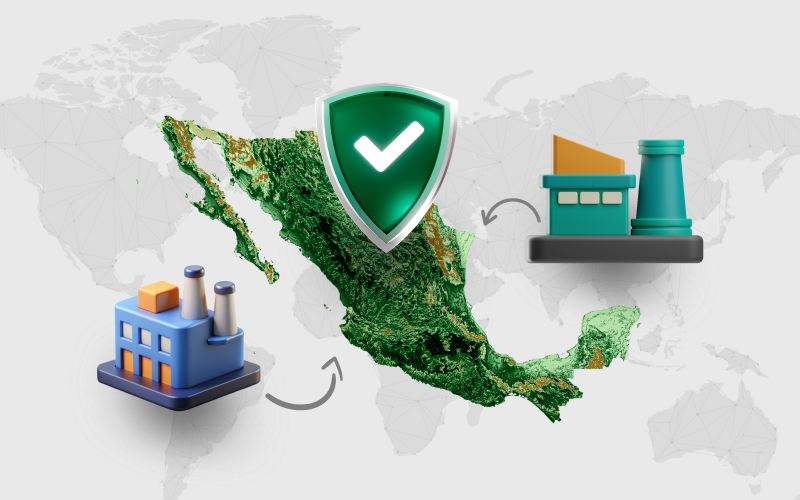
So, it’s no surprise that Mexico is emerging again as the most secure and resilient choice for manufacturers heading into 2026.
Table of Contents
The global manufacturing map looks more fragile than ever
Let’s start with the risk hotspots. Europe’s industrial base continues to absorb the shockwaves of conflict and supply chain fragmentation. In APAC, China’s demand cycles remain erratic, while political tensions have made long-term sourcing from the region increasingly delicate — especially for tech, automotive, and defense-adjacent industries. Energy prices in Asia remain elevated, and in many cases, the carbon footprint of offshore production is becoming harder to justify under new U.S. ESG frameworks.
Freight lanes haven’t helped, either. Between Red Sea route disruptions and Panama Canal drought restrictions, shippers are dealing with re-routed cargo, longer lead times, and rising container rates — none of which are friendly to just-in-time manufacturing.
Mexico wins on resilience, responsiveness, and regulatory alignment
Now let’s zoom in on Mexico. It’s close, within trucking distance of the largest consumer market in the world. It’s integrated through the USMCA framework that (so far) has held firm. And it’s responsive, with suppliers, skilled labor, and logistics providers who can adapt faster than their long-distance counterparts.
Mexico also gives manufacturers something rare these days: predictability. You can quote shipping times in days, not weeks. You can plan for labor costs without wild swings. And you can meet growing compliance expectations — from rules of origin to emissions transparency — with a footprint that’s built to align with North American regulation.
New U.S. policies are pushing production closer to home
The regulatory story is gaining steam in 2026. U.S. agencies have increased enforcement on country-of-origin labeling, tightened enforcement of Uyghur Forced Labor Prevention Act provisions, and signaled broader supply chain transparency requirements under SEC guidance.
For manufacturers with exposure to opaque offshore networks, these rules are a headache — or worse, a liability. Mexico, on the other hand, offers clarity. Cross-border relationships are auditable. Labor standards are improving with real accountability. And suppliers can meet North American compliance demands without a 13-hour time zone gap.
Nearshoring is your best hedge against the unexpected
Nobody knows what the second half of 2026 will bring. That’s the nature of risk. But companies that nearshore to Mexico gain something powerful in return: optionality. If shipping lanes clog, you’ve got a truck route. If regulators crack down, you’ve got compliant partners. If consumer demand shifts, you can pivot without waiting for freight stuck in Shanghai.
It’s not about abandoning global networks entirely — it’s about strengthening the parts that matter most. And Mexico gives you the agility, control, and risk protection that today’s environment demands.
This isn’t just a safer bet. It’s a smarter one
As manufacturers finalize their 2026 plans, the picture is becoming clear. The riskiest decision this year may be doing nothing — or hoping the global status quo returns. For companies that need control, resilience, and responsiveness, Mexico remains the smart move.
Because when it comes to risk, location matters. And right now, Mexico is where strategy meets security.