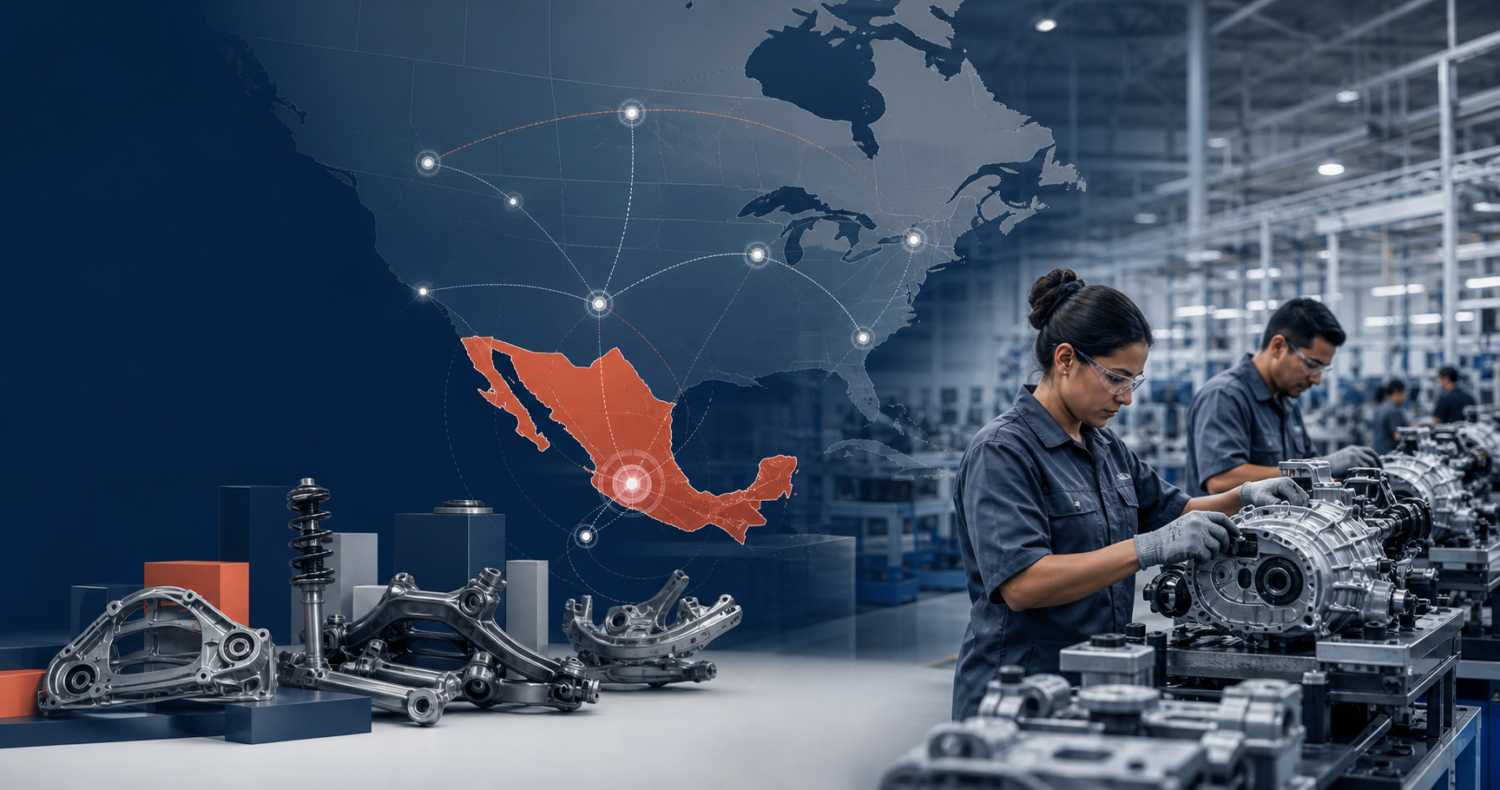

2026 Nearshoring Outlook: Why U.S. Manufacturers Shouldn’t Wait for the USMCA Review
If you’re a U.S. manufacturer, December isn’t just about closing the books and queuing up next year’s CapEx requests. Instead, it should be your final boarding call to get ahead of one of the biggest wild cards looming over North American trade: the 2026 USMCA review.
Signed in 2020, the United States-Mexico-Canada Agreement (USMCA) includes a built-in joint review process that begins six years in. That clock starts ticking in July 2026. And while trade agreements don’t typically vanish overnight, companies with exposure to tariffs, labor provisions, and rules of origin — we’re looking at you, automotive, electronics, and heavy machinery — can’t afford to sit still.
This is the moment to make your nearshoring move. Here’s why.
Table of Contents
1. Uncertainty is not your friend. Location strategy can be.
The coming review won’t necessarily unravel USMCA. But it will invite political gamesmanship, policy jockeying, and potentially, shifting rules that affect how goods qualify for tariff-free treatment.
For instance, stricter enforcement on rules of origin could reshape how auto parts are sourced. Tighter labor standards could affect cost assumptions in Southeast Asia. And tariffs could return to the conversation in ways that impact manufacturing decisions well into 2027.
In short: manufacturers who rely on a finely-tuned, globally stretched supply chain could find themselves reacting instead of steering. That’s not a position you want to be in when the ground starts shifting.
2. Nearshoring isn’t just about cost — it’s about resilience.
The companies we work with aren’t nearshoring just to cut a few pennies per unit. They’re doing it to:
- Control lead times
- Shorten transportation routes
- Gain visibility into quality and compliance
- And reduce exposure to tariffs and global disruption
By producing in Mexico, many manufacturers can confidently maintain USMCA compliance, even if the agreement’s thresholds shift. You’re operating within the agreement’s geography, which is a defensive play as much as it is a strategic one.
And let’s not overlook the fact that cross-border supply chains, when structured well, are faster, more transparent, and more scalable than ever, thanks to Mexico’s growing industrial ecosystem.
3. Infrastructure upgrades in Mexico make this the right time to act
The “Mexico Moment” isn’t hype — it’s increasingly supported by infrastructure reality.
Between 2025 and 2027, Mexico is ramping up investments in roads, intermodal hubs, energy capacity, and industrial parks, especially in states like Nuevo León, Tamaulipas, Guanajuato, and Querétaro. The country is actively positioning itself not just as a manufacturing site, but as a logistics hub for North America.
The sooner companies move, the more choice they’ll have, when considering location, labor, and facility availability. If you wait until mid-2026 to start scouting options, you may find the best industrial space has already been claimed, and local talent is harder to secure.
4. December is the sweet spot for decisions
December may feel like a wind-down month. But in the world of manufacturing planning, it’s crunch time.
Budgets are being finalized. Operations teams are locking in timelines for new product lines. And executive teams are weighing location-based risks and incentives.
If you’re thinking about expanding or repositioning your manufacturing footprint in 2026, the move should begin now, and not after the review period begins.
Closing Thought: Play offense while others hedge
Nearshoring to Mexico won’t eliminate every risk. But it does give you more control over how those risks are managed. And in a policy environment where the rules may soon shift, that control is priceless.
2025 will be remembered as a transition year. For U.S. manufacturers who act now, it can also be remembered as the year they took control of their future supply chain.